
How to Claim WorkCover Queensland
When injured at work, it can be confusing to understand the QLD WorkCover claim process and how to make a common law claim. So, our step-by-step guide to the claim process explains how it works and common barriers to successful work injury payments.
Splatt Lawyers provides legal advice regarding the workers’ compensation process and dealing with the statutory authority on a 100% no-win, no-fee basis. It’s free to know whether you have an eligible claim, your legal options, and the barriers to a successful outcome. Call 1800 700 125
How much is a workers’ comp payout?
How Does WorkCover Work in Queensland?
WorkCover Queensland is the exclusive provider of accident insurance for work-related injuries in Queensland. If you experience a work-related physical injury, illness, or mental health condition, WorkCover Queensland will work with you, your employer and medical practitioners to help you recover from an injury.
Your employer will have work accident insurance, known as WorkCover (unless they have a self-insurer). This workers’ compensation scheme (also called workers’ compensation insurance) was established under the Workers’ Compensation and Rehabilitation Act 2003. Consequently, employers (except for self-insured employers) must have this compulsory insurance to fund their benefits when they claim compensation.
A Queensland workers’ compensation lawyer understands the WorkCover compensation process.
Does WorkCover Cover All Employees?
WorkCover insurance generally covers all Queensland employees for injuries sustained in workplace accidents (although some sizable employers may have self-insurer cover). Generally, casual, full-time and part-time workers are all covered by workers’ compensation schemes in Australia. Furthermore, this compensation insurance includes protection for harm to workers acquired while:
- Conducting work-related business
- Travelling to or from work
- Travelling for work purposes
- Injuries acquired at work activities and events.
What is Covered by WorkCover?
When WorkCover approves your case, you will receive:
- Weekly payments (replacing lost wages)
- Medical practitioners’ costs for physiotherapy, rehabilitation, GP consultations, surgery, blood tests, X-rays, scans and other required assessments or treatments for injury management.
People who receive workers’ compensation can also access other support services, such as:
- Training and Education
- Help with home care
- Access to medical specialists and rehabilitation professionals
Legal Advice for QLD Workplace Injury Claims
Splatt Lawyers offers a free initial consultation for workplace injury claims in Queensland. You can book a free appointment online here.
If you believe your case has been denied unfairly, you have the right to seek legal advice from a Queensland work injury lawyer. Splatt Lawyers can explain injured workers’ rights, including how to negotiate with the workers’ compensation regulator.
Our Queensland personal injury law firm offers 100% no-win, no-fee legal services to all clients. Pay when you win and nothing if you lose. Call 1800 700 125
QLD workers’ compensation lawyers
Can I Make a Claim for Workers’ Compensation?
The eligibility conditions for workers’ compensation claims are outlined in the Workers’ Compensation and Rehabilitation Act 2003. Hence, WorkCover Queensland will consider the following questions when you make a claim:
- Has the statutory claim been lodged within the correct timeframe?
- Was the claimant working for the employer when they had a workplace injury or illness?
- Is the claimant considered to be a worker? (do they meet the definition)
- Was the person’s job significantly contributing to their injury or illness?
NOTE: You must promptly report your work injury to your state’s workers’ compensation authority to initiate the claim process.
It can be complicated to know if you satisfy the eligibility requirements of WorkCover Queensland, but Splatt Lawyers can assess your case for free and advise you of your rights. Call 1800 700 125, or use our free online claim check
How to Claim WorkCover QLD for a Work-Related Injury or Illness
The simplest way to claim workers’ compensation from WorkCover for a work injury or illness is to fill out and submit the online claim form.
However, before you do this, you must know if you are eligible to receive compensation and follow these recommended steps.
5 Steps of the WorkCover Process QLD
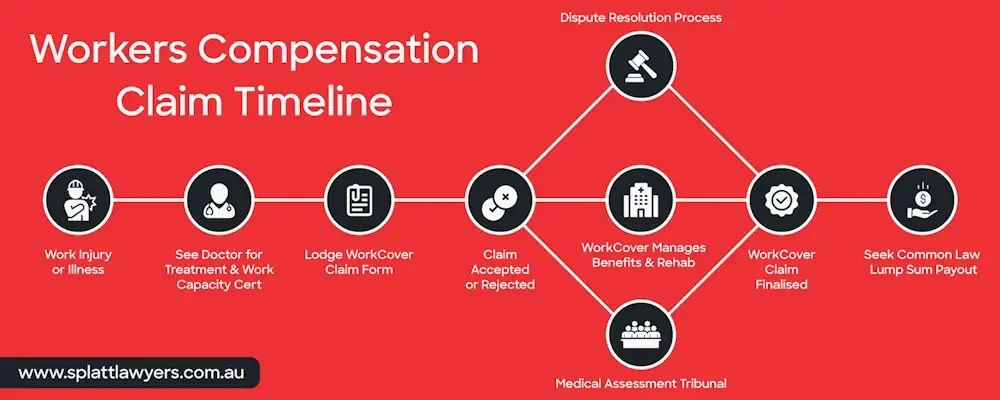
There are five steps to the Queensland WorkCover claim process:
- Seek Immediate medical treatment
- Report your work-related incident
- Get a medical certificate and other documents
- Fill out and lodge a workers’ compensation claim form
- WorkCover assesses your case
1. Immediate medical treatment from a medical practitioner
Start the workers’ compensation process by seeking treatment from a medical practitioner or other health provider. Explain your work-related injuries, including the impacts of your physical or mental injury. They will generally issue you a work capacity certificate.
Typically, a number of treatments do not need prior approval from WorkCover.
2. Report your work-related incident
Please make sure to complete a work accident report that explains where and how the injury happened. Be aware that time limits apply (generally 20 days), so take swift action. All employers are legally required to have an accident register or ledger.
Another option is to file a report by lodging a compensation claim with your boss.
3. Get a medical certificate and supporting documents
When making a workers’ compensation claim, include documents to support your case, such as:
- A copy of your work accident report from the employer you were working with when the illness occurred
- Medical treatment records and assessments from a doctor or general practitioner.
- Receipts for claimable expenses
If you are taking time away from work due to your condition, you will also need a certificate of capacity from your doctor. Please submit these as soon as you can.
4. Fill out and lodge an online claim form
First, you will need a WorkCover medical certificate from your GP. You can then begin the workers’ compensation process by lodging your WorkCover claim online or posting the completed form to the postal address: GPO Box 2459, Brisbane, Qld 4001.
• Please make sure to complete a work accident report that explains where and how the injury happened.
• Be aware that time limits apply (generally 20 days), so take swift action. All employers are legally required to have an accident register or ledger.
5. WorkCover Makes a Claim Decision
According to workers’ compensation legislation, WorkCover has 20 business days to decide your case. During this time they may contact you and your employer to ask questions about your work and injuries.
How Does WorkCover Decide a Workplace Accident Claim?
The process for determining the outcome of a WorkCover claim follows established guidelines and procedures. To do this, they will review the following:
- Did you lodge your case within the applicable time limit?
- Was the injured worker employed when they were harmed?
- Is the claimant classified as a worker based on legislative guidelines?
- Was their employment a significant contributing factor to the work-related injury or illness?
Please know that the Queensland workers’ compensation scheme is a no-fault system, so there is no need to prove who was to blame for your accident (even if you were at fault). However, you must prove liability for your loss for other types of personal injury claims (including common law claims).
What Happens When My WorkCover Claim Is Accepted?
When WorkCover accepts your claim, you will receive weekly compensation payments for lost wages (also called weekly payments). In addition to weekly payments, you may also receive financial support for medical expenses, rehabilitation services, and other necessary treatments.
The value of these payments is based on your previous 12 months’ earnings before your accident. The calculation includes overtime, penalty rates, a higher duty allowance, and others.
These weekly payments will not include reimbursement allowances such as meals, travel, superannuation, accrued leave, or relocation expenses. WorkCover will also reimburse you for medical treatment expenses for your work injury.
WorkCover payments end when:
- You go back to work.
- Your physical or psychological injuries are at their maximum level of improvement.
- You reach the maximum value of weekly compensation.
- You retire from work.
Difference Between Common Law Claims and Statutory Claims
There are 2 types of claims covered by the QLD workers’ compensation insurer:
- Statutory claims (do not need to prove fault)
- Common law claims for employer negligence
The process starts by lodging a statutory claim with WorkCover Queensland. Once approved, you can receive workers’ comp benefits to pay for immediate medical treatment, rehabilitation costs and lost income.
At the end of this process, you can have a permanent impairment assessment that helps determine eligibility for a WorkCover payout and/or settlement of common law damages.
How to Get the Most From WorkCover Payments
How you fill out your WorkCover lodgement form will determine whether you get the most from your weekly payments. So submit your correct pay rate, including regular shift loadings and allowances. Contact your HR department if you are still determining your salary and entitlements.
Strict Time Limits to Claim Workers’ Compensation
There are strict time limits imposed by WorkCover Queensland under the workers’ compensation scheme for both statutory compensation and common law damages. Missing the deadline usually means you cannot seek compensation (with some rare exceptions).
- WorkCover claims: Employees with work-related physical or psychological injuries have six months from the date of the incident to lodge a claim. If you have a medical condition that developed over time, this date will be your first meeting with a medical practitioner regarding a work-related injury or illness.
- Queensland employers must report a work-related injury or illness within eight days of becoming aware of the incident. They can also start a claim without first getting a worker’s consent.
- Common law damages: There is a general time limit of three years from the accident date to start court proceedings for work injury damages.
Note: The above information is not legal advice. Experienced workers’ compensation lawyers can advise on the time limits for your circumstances.
What If My Workers’ Compensation Claim QLD is Denied or Rejected?
Clear reasons will be provided in writing if a claim is not accepted. You can challenge the statutory authority’s decision when a workers’ compensation claim is denied or rejected. Sometimes, WorkCover rejects a case because:
- The workers’ compensation insurer does not believe your physical or mental damage is work-related.
- Your employer challenges your side’s version of events.
- Insufficient supporting documentation
Related Links
How much are work injury damages claims?
What to do after a work accident

Legal Advice for Workers’ Compensation Claims
Navigating the Queensland Workers’ Compensation System to access work-related injury insurance benefits can be difficult. Our work injury lawyers can provide legal advice in this case.
We explain your rights and legal entitlements. Splatt Lawyers provides workers’ compensation legal advice if you have encountered any of the following:
- A work-related injury
- A mental health injury caused by your employment
- Your work escalated a pre-existing injury, illness, or psychological disorder.
- Hearing loss
- WorkCover rejects your work injury case.
- WorkCover won’t pay for medical treatment, surgery, or hospital costs.
- Common law claims for lump sum compensation.
- Your boss is trying to make you return to work.
- Financial hardship due to circumstances outside your control
- You want to know your legal rights.
Splatt Lawyers provides legal insights for WorkCover Queensland processes on a 100% no-win, no-fee basis. Pay when you win and zero if you lose. It’s free to know your rights. Call 1800 700 125

Workplace Accident Claim FAQs
What is the definition of a worker for workers’ compensation?
The workers’ compensation authority considers all PAYG employees, whether subcontractors, part-time, or full-time, to be covered by WorkCover insurance for compensation purposes. However, this definition is complex, so please seek legal advice before making a claim.
What does workers’ compensation cover?
When a work-related injury or illness prevents you from working, Australian workers’ compensation schemes cover:
- Lost wages
- Out-of-pocket expenses
- Travel costs
- Rehabilitation and medical costs
How much does WorkCover payout in QLD?
In Queensland, the value of a lump sum payout under a WorkCover statutory claim is $3,805.75 for each 1% of permanent impairment as assessed using the ISV scale.
What is the maximum payout for workers’ compensation in Qld?
Section 140 of the Workers Compensation and Rehabilitation Act 2003 states that the maximum statutory compensation’ payable for an injury or multiple injuries sustained in a single event is defined as being 216.15 times the Queensland full-time adult’s Ordinary Time Earnings (QOTE).”
In Queensland, the QOTE for the period July 2023 to June 2024 is $1,760.70. After multiplying this number by 216.15, the maximum statutory compensation amount is $380,575.31 for injuries sustained in a single event.
How long does a WorkCover claim take in QLD?
WorkCover has 20 days to determine the outcome of statutory claims for workers’ compensation benefits. On the other hand, common law cases typically take two years or longer to resolve, though some do so in less than a year, depending on the case’s complexity.
How do I lodge a QLD WorkCover claim?
The simplest way to claim WorkCover is to complete and lodge the online form. Then, speak with a workers’ compensation lawyer to learn more about your rights and the claim process.
Do I receive reimbursement for medical costs?
If you have an accepted claim, WorkCover QLD will reimburse reasonable costs for treatment of a work-related medical condition. Often, your treating health provider will send their bill directly to WorkCover.
Who manages workers’ compensation claims in Australia?
In Australia, the Commonwealth, state, and territory governments manage their own workers’ compensation claims to:
- Ensure effective handling
- Timely support for injured workers.
- They can improve workers’ compensation arrangements.
Hence, different laws may apply in each state (and may not cover Australian Government Agency employees). For further information and advice, click on your state below:
- Queensland
- New South Wales
- Victoria
- Western Australia
- South Australia
- Australian Capital Territory
- Northern Territory
- Norfolk Island
Depending on where you live and your occupation, the Safety, Rehabilitation and Compensation Act 1988 covers work-related injuries and illnesses. If Comcare determines your claim, they acknowledge your claim by calling or emailing you.