
Guide to Injured at Work Claims for Financial Assistance
Injured workers may be eligible to lodge an accident-at-work claim and receive workers’ compensation benefits. Unfortunately, injuries at work can happen to anyone and cause financial hardship. While most employers do their best to provide a safe working environment, incidents still occur and can leave you with work-related physical or psychological injuries.
Our legal guide explores workplace liability and the steps to making a work injry claim for compensation. Whether you’re an employee or an employer, this information will be valuable in ensuring you’re protected and informed in case of an accident at work.
Free Consultation for Work Injury Claims
Splatt Lawyers can provide free initial legal advice to explain your rights under the workers compensation scheme, including eligibility to claim damages for non-economic and economic losses.
All our legal services are funded on a 100% no-win, no-fee basis with no upfront costs. Pay only if you have a successful case. It’s free to know where you stand. Speak with our team to learn more. Call 1800 700 125
The Essentials of Accident at Work Claims
Queensland employers generally have a duty of care to provide their staff with a safe and healthy working environment. Hence, full-time or part-time workers who sustain an illness or injury can file an accident-at-work claim against their employer when covered by workers compensation.
If you have been injured at work, you must immediately report it to your employer and seek medical attention. Doing this will ensure that you receive medical treatment and create a record of the incident, which will be helpful later.
- You do not need to prove your employer failed their duty of care to access workers’ compensation benefits for injuries or illnesses until you make a common law claim.
- Workers’ compensation claims require careful preparation and evidence gathering.
Splatt Lawyers provides free initial advice regarding the claim process and your rights. Our personal injury law team can explain how it works. Call 1800 700 125

The Four Main Types of Workplace Injury Claims
Type of Claim | What it Means |
|---|---|
WorkCover Claims | If you can’t work, workers’ compensation can provide statutory benefits. You do not need to prove who caused the workplace injury or illness to have a successful outcome. |
Permanent Impairment Claims | Injured workers with long-term or permanent damage may sometimes be entitled to ‘lump sum compensation’ under WorkCover claims. |
Common Law Claims | Employees may be eligible to seek common-law damages from their employers’ liability insurer for their employers’ negligence. To have a successful common law settlement, you must prove liability. |
Income Protection Claim | Most workers have income protection insurance in their superannuation policy. If you can’t work temporarily due to an injury or illness, this type of insurance payment can partially replace lost wages. |
How do Statutory Claims and Common Law Claims Differ?
The requirement to prove who was at fault for your injury is the main difference between statutory and common law claims.
Type of Claim | Requirement of Proof |
|---|---|
Statutory Claim | If you, your employer, or a coworker caused your injury, you may be eligible for workers’ compensation through a statutory claim. There is need to prove who was to blame. |
Common Law Claim | If you were harmed by your employer or a coworker, you may be able to pursue common law damages. As with any other personal injury claim, you are basically suing for damages. In this case, you will need to prove fault. |
Eligibility to Claim WorkCover When Injured at Work
Any employee who is physically or psychologically injured in a workplace accident could be eligible to make a WorkCover claim. You could receive benefits regardless of who was at fault, whether it was:
- Your negligence
- Negligence of another employee
- Employer negligent
You could make a claim if you have suffered a physical or mental injury while at work or in activities related to your job. Eligibility for compensation also includes conditions acquired by the following:
- Excessive workload
- Repetitive motion
- Work-related hearing loss
Common circumstances where Queensland employers failed their duty of care include:
- Didn’t abide by Queensland Workplace Health and Safety Regulations
- Lack of (or inadequate) risk assessment
- Did not provide employees with quality (or enough) safety training
- Insufficient PPE (personal protective equipment)
- Failed to take sufficient action to reduce workplace hazards
How does workers' compensation help injured workers?
Approved WorkCover insurance benefits provide financial support to employees, regardless of how the injury occurred. These funds can allow them to focus on getting better without being concerned with paying for medical practitioners or rehabilitation services.
A doctor can then assist them with the recovery process so they can complete a return-to-work program.
Strict time limits to make a work accident claim
The time limits applicable to your case depend on the type of workplace accident claim you are lodging.
For WorkCover Claims in Queensland, the time restraint is outlined in Section 131 of the Workers’ Compensation and Rehabilitation Act 2003 (Qld).
- First, you must report your injury to your employer within eight days, which does not trigger the claim process.
- For statutory benefits like weekly payments, you must lodge your case within six months of the incident date.
- If your harm resulted from your employer’s negligence, you could seek a common law payout up to three years from the date of injury.
Missing a deadline often means missing out. An experienced WorkCover lawyer knows the time constraints in Queensland.
Where do I lodge a WorkCover claim form?
Each state and territory of Australia has a workers’ compensation authority where you lodge a WorkCover form. For further information about the different laws, contact the below with supporting documentation.
- WorkCover Queensland
- Australian Capital Territory
- New South Wales
- South Australia
- WorkCover WA
- Victorian WorkCover Authority
- Tasmania
- Norfolk Island
How to Make an Accident at Work Claim
Understanding the claims process is crucial for injured workers seeking compensation. An experienced injury-at-work lawyer can explain the claims process.
- You must verify that your employer had a duty of care towards you and failed by either not providing adequate training or equipment, or maintaining a safe working environment.
- You must show that this failure caused your workplace injury or illness.
Employer negligence is often the primary cause of workplace accidents, making it easier for employees to make their cases, since employers have strict legal obligations to ensure their staff are safe on company premises.
However, if the employee helped cause their injuries, illness or psychological disorder (such as being under the influence during work hours). The insurer’s lawyer can argue a contributory negligence defence.
Another possible scenario is when third parties, such as contractors or visitors, are liable because they directly caused an accident. In this case, the employer may still owe damages as they are responsible for everything within their business setting, including anyone who enters their premises, whether invited or uninvited.
Steps to Take When Injured at Work
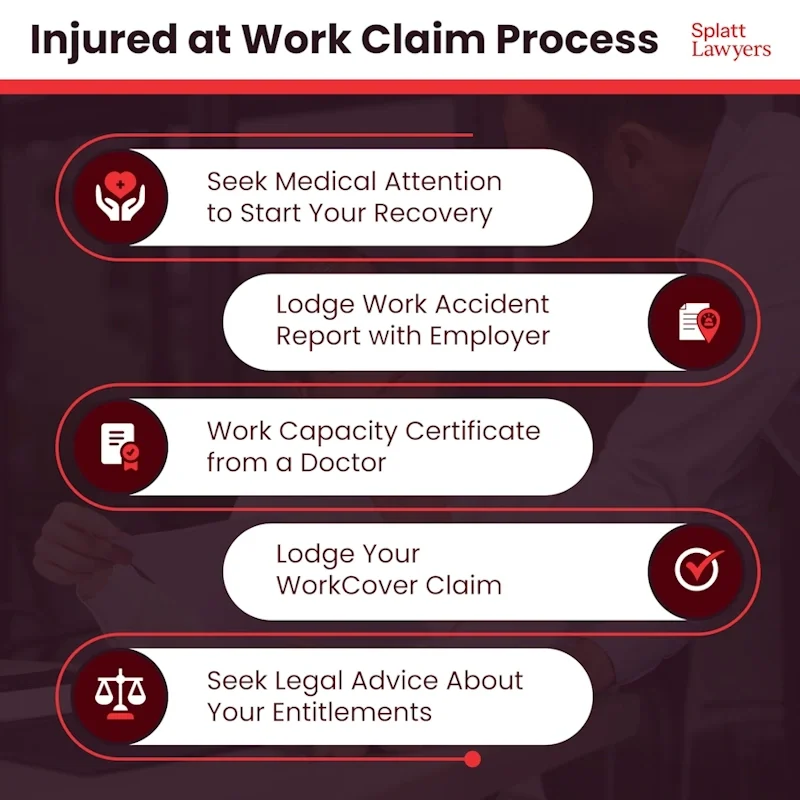
In Australia, to file a work-related injury claim, you must report the incident to your employer immediately, seek medical treatment to obtain a WorkCover Certificate of Capacity, and complete a formal workers’ compensation claim form. These are the steps of the work accident claim process for a workplace injury.
Report the Work Accident to Your Employer
The first step is to promptly report the incident to your employment provider. Employers are required to notify their workers’ compensation insurer within eight days of receiving notice of an injury. They must also keep a register of workplace injuries.
Please note: the insurance company will investigate the case, not your employer.
Get a Medical Certificate
Next, visit your doctor for a medical examination and request a work capacity medical certificate.
Lodge a WorkCover Claim
Fill out and submit an online claim form to WorkCover, along with the required supporting documents. These are typically reports, forms and expense receipts.
You will receive a WorkCover claim number.
WorkCover Assessment
WorkCover Queensland has 20 business days to complete an assessment. They may request further information during this period.
Get Legal Advice from a Work Injury Lawyer
- A qualified personal injury lawyer can explain your options and entitlements under your state’s workers’ compensation scheme.
- They typically provide free initial advice that can help when you are unsure of your options.
Receive Financial Support or Dispute Rejected Claim
If your workers’ compensation claim is rejected, you should dispute the decision by first utilising a free conciliation service, and if that fails, you can take the matter to court.
Types of Compensation Benefits You Can Claim for Work Accidents
You may be entitled to workers’ compensation if you have been injured in a work accident. The value of a lump sum payout and weekly payments will depend on the severity of your injuries and their impact on your life.
Type of Compensation | What You Can Claim |
|---|---|
Economic Damages | Covers financial losses you have incurred due to the accident, including medical expenses, lost wages, and any other out-of-pocket expenses related to your injury. Hence, you should keep records of expenses for evidence to support a workers’ compensation claim. |
Non-Economic Damages (General Damages) | Non-economic losses cover pain and suffering from a workplace accident, including physical and emotional trauma, loss of enjoyment of life, and any ongoing pain or discomfort. |
We recommend you keep track of all expenses related to an injury as evidence to support a claim for special damages.
A personal injury lawyer can advise on eligibility for a lump sum payment and help calculate your entitlements based on your circumstances. It’s free to know your entitlements. Call 1800 700 125
Types of Workplace Accidents Covered by the Workers' Compensation Scheme
Any type of work-related accident, illness or mental health condition can qualify for workers’ compensation claims that occur either:
- On the job
- Travelling to or from work
- Or during work-related activities
Common types injuries for workers’ compensation claims include:
- Slips, trips, falls
- Back injuries from lifting heavy objects
- Repetitive strain injuries
- Hearing loss due to noise exposure
- Exposure to dangerous chemicals
- Psychological harm caused by work stress, depression and anxiety
- Crushing injuries
- Head injuries from falling objects
You should report incidents leading to these conditions to both the employer and the state and territory workers’ compensation authority as soon as possible.
How Much Compensation Can I Get for a Work Accident Claim?
How much compensation you may receive for a work accident claim depends on:
- The severity and nature of your injury
- How much it has impacted your capacity to do your job.
- Your current salary
- How long you were off work
These elements may be considered when calculating work injury damages:
- Your future and past lost income
- Future and past lost superannuation
- Medical treatment costs
- Travel expenses related to your condition
- Rehabilitation expenses
- Lost enjoyment of life
- Pain and suffering compensation
- There can be limits on the maximum compensation you can receive under Queensland workplace personal injury laws. (depending on the type of claim).
- However, there are no maximum limits of common law damages for workplace accident payouts.
- You have the right to seek legal advice from a work accident lawyer for workers’ compensation claims. They can assess your circumstances and advise you appropriately.
4 Common Mistakes When Filing a Work Accident Claim
1. Failing to immediately report the accident
Failing to report the incident immediately is a common mistake when filing a work accident claim. Omitting this step can significantly affect your chances of receiving compensation, as there may be no record or evidence of your incident. Delayed reporting can cause:
- Doubt about the severity of your work-related injuries
- Whether they are related to your workplace accident
Hence, you should report any accidents promptly, even if you don’t think you have a serious injury or that it warrants a claim.
Doing so will give you a better chance of getting WorkCover compensation and protecting your rights.
2. Not seeking medical attention as soon as possible
Another significant mistake you can make when filing a work accident claim is not seeking treatment or following treatment plans. Doing this can:
- Severely weaken your case
- Make it challenging to prove the extent of your injuries
- Medical treatment can help you recover and provide vital evidence for your claim.
- Remember that the liable party may use any delay in seeking medical attention or failure to follow treatment plans against you.
3. Providing inconsistent statements or leaving out details
Inconsistent statements or missing key details can significantly undermine an accident-at-work claim.
- Insurance adjusters and their lawyers will be looking for any inconsistencies in your story
- Avoid embellishing or exaggerating the facts of the case
Also, be sure to provide a detailed account of all injuries sustained and medical treatment received. Include these crucial details to avoid a lower settlement offer or a denied claim.
4. Settling too quickly or without legal representation
Settling too quickly or without legal representation are two of the most common mistakes to avoid when filing an accident at work claim.
- The workers’ compensation insurer typically offers a quick settlement that seems fair, but are typically much lower than your legal entitlements.
- Settling without legal advice means you could miss out on valuable compensation and benefits that a skilled personal injury lawyer can help you access.
How to Gather Evidence When Making a Claim
You must gather strong evidence that proves your employer’s liability for an accident at work claim. Evidence can include:
- Witness statements
- Photographs and video of the accident scene
- Medical records
- Work accident reports
- Witness statements can be more reliable soon after the accident, while photographs and videos may be less valuable if taken days or weeks later.
- You should also report the accident to your employer quickly and seek medical attention if necessary.
- You should also record any expenses you incur from the accident, such as medical bills or lost wages.
If your employer disputes liability for the accident, you may need to gather additional evidence to support your claim. These documents could include:
- Expert testimony from a safety consultant or workplace safety specialist
- Documentation showing that your employer failed to follow industry regulations or safety standards
Legal Advice from Experienced Workers' Compensation Lawyers
In Australia, you have the right to seek legal advice from a personal injury lawyer when filing an accident at work claim.
During an initial consultation, ask about their fees and what services they will provide. A Brisbane personal injury lawyer will be transparent about fees and usually offer no-win, no-fee legal services. They should also give you a clear understanding of the legal process and your options.
- A lawyer can help you gather evidence to strengthen your case, including medical records, witness statements, and other relevant documentation.
- They will also negotiate with the insurance company to ensure you receive fair work accident compensation.

FAQs for Injury at Work Claims
Who funds a work accident payout?
In Queensland, all employers must have workers’ compensation insurance to cover the costs of employee injuries. This workers’ compensation insurance scheme is called WorkCover and provides financial assistance and medical expenses for employees who sustain a work injury.
If your claim is successful, your employer’s insurance policy will usually pay for the cost of a compensation payout.
What is the workers’ compensation regulator?
WorkSafe is the Queensland workers’ compensation regulator, which is part of the Office of Industrial Relations.
This statutory body develops effective and fair management of the workers’ compensation scheme to meet the demands of both employers and employees.
What if my employer denies liability for my workplace accident?
If your employer denies liability for a workplace accident, you can get legal representation from a Queensland personal injury lawyer.
An experienced workers’ compensation solicitor can review the facts of your case and help you build a strong argument supporting your claim.
Where do I lodge a workers compensation claim?
The Australian government has set up a statutory workers’ compensation authority for each state. They are responsible for managing their work injury insurance scheme. Contact the below for further information.