
How long a personal injury claim takes in Australia depends on several factors. On average, the personal injury claim process usually takes 9 to 18 months, although some claims settle within a few months and more complex matters can take longer than a year.
If you have suffered an injury and want to know how long your claim may take, especially in Brisbane or elsewhere in Queensland, the answer depends on the:
- Type of case
- Available evidence
- Steps needed to prove an injury claim
Public liability claims, motor vehicle accident claims, medical negligence, and workers’ compensation claims all follow different timelines.
If you know what to expect, you can avoid delays that affect how long it takes to get a payout. Our legal guide explains:
- The average time frame for a personal injury claim
- The stages of the claims process
- The main factors that affect settlement time
- Why some matters take longer than others
- The key legal time limits that apply in Queensland
- The steps you can take to speed up the process
Free Consult for Claiming Compensation
You could be eligible to claim compensation if you have been physically or psychologically harmed by someone else. Our personal injury lawyers offer a free consultation and legal representation on a 100% no-win, no-fee basis.
There are no upfront costs, hidden charges or uplift fees. Pay for a win and zero if you lose. Call 1800 700 125
We can also answer the question: How long does a personal injury claim take based on your unique circumstances?
Average Duration of Personal Injury Cases
The duration of personal injury cases varies significantly by the Queensland compensation scheme. Here is the average duration by claim type.
Type of claim | Average duration |
|---|---|
Compulsory Third Party (CTP) claims | 18 to 24 months |
Workers’ compensation claims | 6 to 36 months |
Public liability claims | 18 to 30 months |
Medical negligence claims | 24 to 48 months |
TPD claims | 6 to 24 months |
Key Factors for the Average Duration of Personal Injury Claims
Shorter Settlements
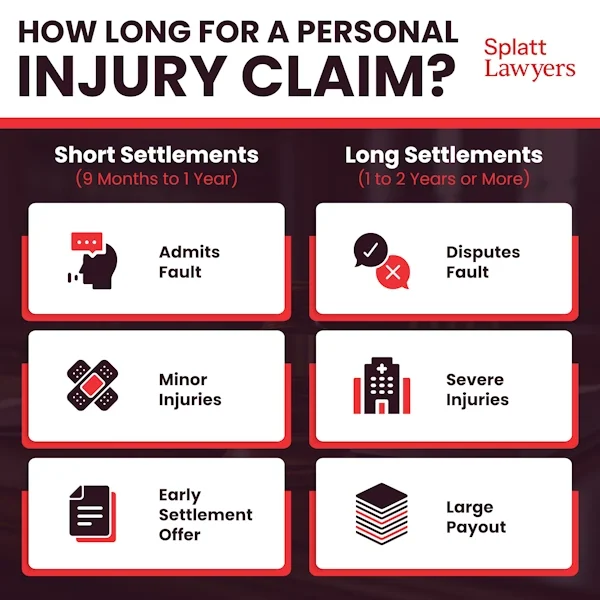
A straightforward personal injury claim could resolve within 9 months to 1 year. These cases usually involve one or more of the following:
- Minor Injuries: A minor injury claim with a lower payout value can settle in a short timeframe(e.g. whiplash and other soft-tissue injuries) The liable insurer responds with an early offer to avoid paying for legal fees.
- Insurer accepts liability: The insurance company admits their liability to pay damages, which speeds up negotiations and results in a faster settlement.
- Pre-Litigation Settlements: Most straightforward personal injury claims settle through mediation without filing a lawsuit. In this situation, an early settlement offer results in a faster payout.
Queensland legislation encourages parties to negotiate an early resolution to a personal injury case. For example, the Personal Injuries Proceedings Act 2002 (QLD) requires them to swap information and try to resolve a matter without expensive court proceedings, which helps reduce the settlement time.
Longer Settlements
A longer settlement takes more than one year to pay out. These are usually complex claims with disputed liability or how much to award in damages. The factors contributing to longer settlements include the following:
- Large Settlement Amounts: Insurance companies typically strongly defend personal injury cases involving large settlement amounts, which often causes cases to take more than two years to settle.
- Severe Injury Claims: Traumatic brain injuries and spinal cord injuries have long recovery times with ongoing care and multiple specialised medical reports. They can also require expert opinions.
- Court workload: The Brisbane court system has limited capacity to process cases, which can lead to backlogs and longer settlement times.
- Disputed Liability: A case will take longer to settle when the other party and/or the insurer denies liability for the accident. In this case, there is a lengthy legal process in which each party collects witness statements and other strong evidence to prove their case.
The settlement time also varies depending on Brisbane’s legal system and conditions imposed by the Civil Liability Act 2003 (QLD). This legislation provides guidelines for the assessment of damages and the recommended steps for resolving a personal injury case.

Why Do Personal Injury Claims Take a Long Time?
Personal injury claims take a long time for various reasons. Here are some factors that can affect the timeline.
Injury Severity
- Serious injuries have a longer recovery time. The injured person often requires more medical care, rehab and sometimes future ongoing care.
- Psychological injuries often take longer than minor physical injuries to recover, resulting in a longer claim process.
- It takes time to understand the full extent of severe injuries and their long-term outcomes.
- These types of cases often need multiple medical reports, comprehensive evaluations and expert testimony.
Case Complexity
- To win a Brisbane personal injury case, you need time to gather detailed evidence proving the fault of the other parties involved.
- If multiple parties caused your injuries (e.g., in a multi-vehicle accident or a faulty product claim), there will be liability disputes that extend the settlement period.
- Severe injury claims with high payouts often lead to extensive negotiation and arguments over compensation, resulting in a longer case.
Maximum Medical Improvement
Damages in a personal injury case cannot be assessed until the injured person has reached maximum medical improvement, at which point further treatment is not expected to improve their condition.
Maximum Medical Improvement (MMI) indicates that the medical condition has stabilised, a key factor in determining fair compensation. Once the claimant has reached MMI, an accurate, independent medical assessment of permanent impairment and future care needs can be conducted.
You could be undercompensated if you settle a personal injury claim early (before reaching MMI), because damages can include future economic losses such as ongoing medical care and other expenses.
- Injury severity usually determines MMI; e.g. soft tissue injuries could take from 6 to 12 months, while severe injuries like spinal cord damage could take several years.
- Advice from medical experts and personal injury lawyers can help you understand the full extent of the injury and future impacts.
- At this stage, insurer conduct can also delay a claim because they typically argue the injuries are less serious and will request further medical examinations.
- If claimants understand the importance of MMI, they can avoid unnecessary delays and get compensation that covers their current and future losses from the injury.
Quality of Available Evidence
- It is a time-consuming process to collate police and accident reports, witness testimony, medical records, work accident reports and other expert assessments.
- There can be delays while chasing professional advice. Furthermore, anything that requires further investigation to resolve liability dispute will delay a case.
Multiple Liable Parties
A personal injury claim takes longer to resolve when there are multiple parties that caused the accident. These are often motor vehicle accident claims and product liability cases.
- There will be multiple legal teams presenting conflicting legal arguments to minimise their liability.
- Often each party has their own insurance company, legal representatives and expert witnesses.
- The legal process is longer when it involves multiple parties, and addressing various legal arguments can be complex and lengthy.
Insurer Conduct
Insurance companies used various tactics to delay, reject or minimise claim payouts, including:
- Saying the injuries are less severe
- Offering low payout amounts
- Assigning a private investigator to monitor the claimant
Insurers also have the option to seek a lot of documentation and run their own investigation, which often causes delays.
The procedure can be further prolonged if the insurance company is unwilling to negotiate a fair settlement, leading to the possibility of court proceedings.
Court Schedules
A personal injury claim takes longer when court schedules are heavily booked.
Queensland courts often become overloaded with work, which means pre-trial motions, hearing dates, trials and settlement conferences are delayed. If the judges and courtrooms are heavily booked, the legal process and court proceedings will be delayed. Hence, court schedules can lead to significant delays in hearings.
Also, court proceedings are often longer for complex claims that involve disputed liability.
The Personal Injury Claim Process Explained
The settlement process typically involves immediate steps like seeking medical treatment and reporting the accident. You can avoid unnecessary delays by understanding the steps of the claim process that follow.
1. Legal Advice

In Queensland, you have the right to seek legal representation and advice from an experienced personal injury lawyer. They can advise
- If you have a valid personal injury claim
- Investigate your accident and injuries
- Advise who was at fault (or if there are multiple parties involved)
- Give you an estimated settlement period
If you hire a lawyer, they can explain the importance of medical stabilisation and help gather evidence such as:
- Your medical records
- Witness statements
- Reports that explain how the injury occurred
- Any other related documents
2. Pre-Litigation Phase
The pre-ligation phase can vary depending on the type of claim. This is because motor vehicle accident, public liability claims, WorkCover compensation and medical negligence claims involve different types of insurance policies and claim processes.
However, the general process is that your lawyer will issue an initial notice to the insurer of the liable party and attempt to resolve the case through mediation. This step usually requires expert medical evidence and accident reconstruction reports, to support your case.
Your personal injury lawyer will also prepare an accurate statement of damages that considers your:
- Medical expenses
- Lost wages and superannuation
- Pain and suffering
Personal injury laws also impose strict limitation periods that can change based on:
- The type of claim
- How the accident happened
- Your age at the time of the incident
3. Litigation Phase
Less than 5% of Queensland personal injury claims will enter the litigation phase, as most settle by mediation. Hence, the vast majority of claims will avoid expensive court proceedings.
A case will proceed to the litigation phase only if it doesn’t settle during the pre-litigation phase. In that case, your legal representative will lodge a personal injury claim with a Brisbane court with the details of the other party. At that point, the defendant can respond.
The discovery process involves parties:
- Exchanging documents and evidence
- Answering written questions and depositions (sworn statements)
4. Settlement Negotiations
Settlement negotiations are possible at any point in the litigation process but tend to ramp up after discovery. The parties involved could use an independent mediator or negotiate directly, with the goal of reaching fair compensation without going to trial.
- Queensland courts encourage settlement through mediation to save time and costs.
- When negotiations are successful, a settlement agreement is reached that outlines how much compensation the claimant will receive.
5. Court Proceedings
A case might proceed to court if settlement negotiations fail. An experienced personal injury lawyer would advise the claimant of their options and possible outcomes.
During court proceedings, the claimant and the defendant would make their legal arguments based on the available evidence and witness statements.
During legal proceedings for common law claims, the claimant must prove the following:
- The defendant caused the accident
- The injuries were from the accident
- The injuries caused and related financial loss
Brisbane personal injury trials can be heard in the Supreme Court, Magistrates’ or District Courts
6. After-Trial Proceedings
At the completion of a trial, either party can appeal the court’s decision if they believe there was a legal error. Alternatively, an enforcement order may be issued if the defendant doesn’t pay damages.
Once the claimant receives a payout, they cannot seek further compensation if their condition deteriorates. However, people who have a successful claim may also be eligible to make a TPD claim.
How Can I Speed Up a Compensation Claim?
Personal injury claims take a long time, but you can help accelerate the legal process with the following top tips:
Action | How it works |
|---|---|
Attend medical assessments | All personal injury claims require medical reports, often from a specialist doctor who is heavily booked. If you miss your appointment, you may not see them for months. |
Answer information requests within 48 hours | Your lawyer and the insurance company will ask for documents to progress your claim. Late replies will slow the progress of your case. |
Tell the truth | Always be honest about your medical conditions, particularly any relevant pre-existing injuries. Conflicting information will cause delays in assessing damages. |
Follow your treatment plan | Any gaps in treatment, or failure to follow a rehab plan, will be regarded as an indication that the injury is not significant, which will delay your claim. |
Support from Experienced Personal Injury Lawyers
The process of making a personal injury claim in Queensland can be complex, particularly when dealing with insurance companies and the legal system. But experienced personal injury lawyers know how to have a successful claim.
They can provide specialist advice on your circumstances – how long your claim may take and what may cause delays. Personal injury lawyers can assist by:
Providing an obligation-free consultation to assess your case without any initial cost or commitment.
- Explaining the correct compensation scheme, such as compulsory third-party insurance for motor vehicle accidents or WorkCover for workers’ compensation claims.
- Helping you gather and organise all necessary evidence, including medical reports, witness statements, and accident documentation, to build a strong case.
- Communicating and negotiating with insurers to prevent tactics that could unnecessarily delay your claim.
- Ensuring you meet all legal deadlines to avoid jeopardising your right to compensation.
- Providing realistic expectations about how factors such as injury severity and liability disputes may affect the timeline.
Personal Injury Compensation Settlement Time FAQs
Do I need to hire a lawyer for a personal injury case?
You could handle a straightforward claim for minor injuries without legal representation if the liable insurance company is not disputing your claim. Just be aware that they will likely make a lowball offer to quickly settle a personal injury claim.
Self-managing a claim can help you save legal fees, but this may be a false saving because an experienced personal injury lawyer can:
- Prepare a comprehensive statement of damages with supporting evidence to achieve further compensation
- Can increase your chance of a successful claim
- Will work on a no-win, no-fee basis
What is the limitation period for personal injury compensation claims in Queensland?
There are multiple limitation periods for Queensland personal injury claims that change depending on the type of claim and your age at the time of the accident.
For common law claims (suing for damages), there is a general time limit of 3 years from the date of the accident or from becoming aware of the injury.
Some compensation claims have a much shorter time limit, such as nominal defendant claims, which range from 3 to 9 months, depending on circumstances
- You must lodge WorkCover statutory claims within 30 days.
- There are exceptions for people who were injured when they were under 18 and for an injured person who is mentally incapacitated.
You should seek professional advice to be certain of the time limits for your case, as missing the limitation period typically blocks your right to claim compensation.
What are the signs of a good settlement offer?
Good settlement offers are characterised by full coverage of damages, open and honest calculations and no artificial pressure to settle.
A good settlement offer will cover:
- All past and future medical expenses, including future medical treatment
- Reimburses all lost income and superannuation
- Includes fair compensation for pain and suffering and emotional damage
- Follows the insurance company’s policy limits
How much can I expect from a personal injury claim?
Queensland personal injury payouts are approximately the following:
- $19,200 for statutory WorkCover claims (more psychological injuries)
- $128,200 for motor vehicle (CTP) claims
- $182,296 for common law workplace settlements
However, serious or catastrophic cases can reach 7-figure payouts
How long do most personal injury cases take to settle?
- In Australia, most personal injury claims resolve in 9 to 24 months, but injury severity, liability disputes, and the time needed for medical stabilisation are key factors that can affect the timeline.
- Severe injuries require longer treatment and assessment, so they often take longer to settle.
What are the stages of a personal injury claim?
- The stages of a personal injury claim typically include getting medical treatment, making an accident report, collecting evidence, and lodging a formal notice of claim form with attached evidence.
- A case generally moves from initial investigation to negotiating damages, a final settlement or court action in some cases.
Back to Top: How long does a personal injury claim take