
Home > QLD Psychological Injury Lawyers for Mental Health Claims
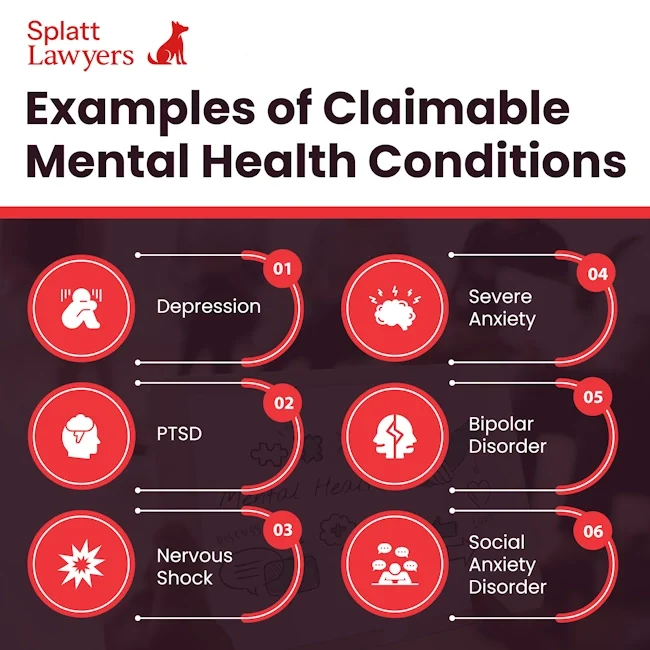
Our psychological injury lawyers provide mental health compensation legal advice when you have suffered a psychological injury due to another person or party’s negligence. In this situation, you may be entitled to make a psychological injury compensation claim for a recognised mental illness, such as:
In Queensland, you may also be eligible to claim workers’ compensation for work-related psychological injuries.
Splatt’s personal injury lawyers offer a free consultation and legal advice for mental health claims on a 100% no-win, no-fee basis. Pay when you win and zero if you lose. It’s free to be sure. Call 1800 700 125
100% No-Risk Guarantee
Capped Fees
We Cover Outlays
Direct Access to Senior Lawyer
In Australia, a psychological injury claim can cover emotional, cognitive, and behavioural symptoms caused by work-related incidents, and typically requires a formal diagnosis from a qualified mental health professional.
You could have the right to seek compensation under the Queensland Workers’ Compensation and Rehabilitation Act 2003 (or other personal injury laws) when you suffer a mental health injury because another person or party failed to keep you safe.
Common claimable mental health conditions include depression, anxiety, stress, nervous shock, post-traumatic stress disorder (PTSD), and social anxiety disorder.
Expert lawyers can explain your eligibility to seek compensation and the claims process.

Mental health claims generally fall into categories such as workers’ compensation, disability/income protection, and public healthcare or insurance.
In Queensland, a range of mental health injuries can be eligible for a compensation claim. Some common claimable psychological conditions include the following:
PTSD is typically triggered by observing a traumatic event or series of incidents for an extended period.
Psychological injury claims often arise from ongoing pressure, traumatic events, or unlawful behaviour in the workplace, and can include conditions like PTSD and depression.
Workers’ compensation lawyers can explain how it works.
Work injuries include both physical injuries and mental health conditions. They can be caused by:
Personal injury lawyers can explain your right to claim work injury damages.
You can experience emotional distress when recovering from a personal injury, or it can originate from undesirable behaviour like workplace bullying.
You could claim compensation for emotional distress when you suffer mental harm due to someone else’s duty of care failure. To have a successful claim, the injured party must show that:
When your mental illness prevents you from working again in your regular occupation, you could be eligible to claim a lump sum TPD insurance payout through your superannuation.
Note: For personal insurance claims, it doesn’t matter how your injury was acquired.
You could be eligible to receive permanent impairment compensation under your state’s workers’ compensation system (according to WorkCover QLD). In that case, you would have a medical assessment with an independent medical examiner
When your psychological disorder is due to another party or person’s full or partial negligence, you could have the right to make a common law claim. In this case, you are suing the at-fault party’s insurance company for damages.
For example, when your employer causes you mental harm, you sue the QLD workers’ compensation insurer.
Psychological injuries can have the same level of severity and impact on individuals as physical injuries. The amount of your mental illness compensation will depend on.
Under the QLD Work Health and Safety Act 2011 (WHS Act), everyone has the legal right to a healthy and safe workplace. If you have a workplace injury that has damaged your mental well-being (i.e. your work was a significant contributing factor), you could claim workers’ compensation.
The success of workers’ compensation claims for work-related mental injury relies on linking your mental damage with your occupation (either fully or partly). Your job-related injury could have influenced your behaviours, emotions, feelings and thinking and been expressed as either:
Actions and events that can lead to mental health problems include the following:
Mental health claims are formal requests made by an insured individual or their healthcare provider to an insurance company for payment or reimbursement of mental health services.
Proving a psychological injury case is typically more difficult than a physical one, as the medical condition is not visible. That’s why you will need the following:
According to WorkCover QLD, a mental injury (also called ‘psychiatric’ or ‘psychological’ injuries) is any illness or medical condition that changes your feelings, thoughts or behaviours, disrupting your daily life and work duties. Common examples include conditions such as:
Mental health injuries can be triggered by a traumatic event, a catastrophic accident or other stressful situation or associated with a physical injury.
For WorkCover claims, a “mental injury” is defined by the Workers’ Compensation and Rehabilitation Act 2003 as a recognised psychological dysfunction that causes behavioural or cognitive issues. They are often diagnosed by a GP or other medical practitioner, such as a psychiatrist or psychologist.
Understanding the legal process of a psychological injury claim in Australia could help you have a successful outcome.
Immediate help from a medical practitioner: This step will establish a formal diagnosis and a treatment plan. Early support can also support your recovery and provide evidence for a WorkCover claim (or other compensation claim).
A general practitioner (GP) can also prepare a Mental Health Care Plan, which you will likely need to access treatment rebates through Medicare.
Report the injury to your employer and the relevant workers’ compensation authority for your state (for WorkCover claims). Otherwise, lodge an accident report with the public liability or CTP insurer.
Insurers may use “utilisation reviews” to audit clinical notes and assess the necessity of ongoing therapy.
Collect medical evidence to support your case. Claimants should also keep detailed incident reports and witness statements related to their medical condition, as these documents can help support a mental health claim.
Get legal advice: Experienced psychological injury lawyers regularly deal with insurance companies and know what it takes to prove a case and achieve a successful outcome.
Lodge a claim form with all the relevant documents, including a statement of damages.
Receive a settlement or challenge a rejected case with court proceedings. Most claims are resolved through mediation.

How much you can seek in lump sum compensation depends on the type of personal injury claim and your unique circumstances, including the following:
Most people can qualify for more than one psychological injury claim, including:
A free case review with our psychological injury lawyers can assess how your circumstances impact the resolution of a compensation claim. Call 1800 700 125
Common Law Claim: According to QLD workers’ compensation scheme statistics 2022-2023, the average lump sum payment for a psychological injury common law settlement was approximately $68,000.
Whole Person Impairment Claim: In Queensland, lump sum payments for psychological injury do not require a minimum permanent impairment rating. For successful workers’ compensation claims, whole-person impairment lump sum payouts range between approximately $57,000 and $631,000
Mental Injury TPD Claims: You make a TPD claim for mental injuries when you can’t work again in your usual occupation. A successful TPD lump sum payment in Australia ranges from $50,000 to $500,000. Some people with multiple superannuation accounts can make more than one claim for the same mental health condition,
Type of Claim | Lodgement Deadline |
|---|---|
Common Law Claim | Within 3 years of the incident giving rise to the claim (with some rare exceptions) |
Workers’ compensation claim | 8 days to report the injury, 6 months to lodge WorkCover claim, 3 years for common law damages |
Road accident claim | 9 months to lodge CTP claim form, 3 years for personal injury compensation. Much shorter deadline if other driver is unknown/unidentified. |
Public liability claims | Within 3 years of the accident date |
Permanent Disability Insurance Claims | Generally, no time limit to lodge a claim through a superannuation fund |

A claim for psychological or mental injury damages is based on a diagnosed disorder caused by the negligence of others. In this situation, a personal injury lawyer explains how to establish liability for your financial loss. They assist you in proving psychological injury and identifying who was at fault.
Splatt Lawyers’ mental health compensation team explains your rights and entitlements in plain English. It’s free to be sure. Call 1800 700 125
There are several mental health support services available to those living with a mental injury. You could access support for your recovery via your case manager or your Nominated Treating Doctor (NTD).
Our personal injury lawyers can explain your rights and eligibility to claim lump sum compensation for a mental illness caused by the negligence of others, from ten QLD-wide locations.

You can make a work injury damages claim for a workplace psychological injury when your job significantly contributes to your mental disorder.
The time it takes to settle a common law claim for a mental illness on the case’s complexity and, often, the settlement size.
In Australia, the average compensation payout for psychological injury claims can range from $50,000 to $500,000, depending on the severity of the condition and the type of claim made.
In Australia, a significant contributing factor to psychological injuries can be workplace bullying, which is associated with anxiety, depression, and other mental health disorders.







Keeping you up-to-date and informed with relevant facts and news about the
world of compensation law, our law firm and our services