
How to Make a Personal Injury Claim
You should know the personal injury claim process if you are the injured party in an accident caused by the negligence of others. Having a solid understanding of the legal process and court proceedings can increase your chance of securing a personal injury compensation payout.
Lump sum financial compensation can help you recover from injuries sustained in an accident, including
- Medical treatment costs
- Doctor’s bills
- Lost income
- Pain and suffering
Our legal guide for the claims process explains everything you must know to recover damages under Australia’s personal injury laws.
Free Legal Advice for Personal Injury Claims
Splatt Lawyers is a Queensland law firm that specialises in providing advice for personal injury matters, with no-win, no-fee services. We offer a free initial consultation that:
- Discusses your psychological or physical injury
- Can explain your eligibility to claim compensation
- The strict time limits that apply to your personal injury case
We offer legal representation on a 100% no-win, no-fee basis with no upfront costs or uplift fees. Call 1800 700 125
Personal Injury Claims Explained
If you have suffered harm from someone else’s whole or partial negligence, you could start the legal process of seeking compensation known as a personal injury claim. In this case, you would be recovering damages for your:
- Medical expenses
- Pain and suffering
- And lost income
The liable insurance company of the negligent person or party pays the agreed personal injury compensation that settles the claim.
Common Injuries for Compensation Claims
A personal injury includes both diagnosed psychological and physical medical conditions. Common examples include the following:
- Fractures
- Soft-tissue injuries such as whiplash
- Head and brain trauma
- Spinal damage
- Cuts, abrasions, and bruises
- Hearing and eyesight damage
- Lower limb injuries
- Chemical burns
- PTSD
- Severe depression and anxiety
If you have a valid case, the personal injury claim process can provide you with the financial resources you need to get back to normal.
Common Types of Compensation Claims
In Australia, personal injury claims can be categorised into four main types: motor vehicle accidents, workplace injuries, medical negligence, and public liability claims. The circumstances surrounding the injury or illness determine the type of case.
Car Accident Claims

Motor vehicle accident claims cover injuries and damages sustained by drivers, passengers, cyclists, and pedestrians involved in road incidents.
An injured person could be eligible to claim compensation for a car accident caused by negligent or dangerous driving, regardless of the type of vehicle involved.
- Inside or outside a motor vehicle
- Riding a bike
- Motorcycle riders
- While using public transport
- Truck drivers
- Hit-and-run accident
- Pedestrians
- Uber, Taxi or Rider
- E-scooter and e-bike riders
Workplace Injury Claims
You could be eligible to receive workers’ compensation benefits if you have suffered harm due to a failure of workplace health and safety standards or employer negligence.
- A successful workplace injury claim could replace lost wages and cover medical expenses during your recovery.
- Legal professionals can advise on your eligibility to seek work injury damages.
Public Liability Claims
Public liability claims involve injuries sustained on public or private property due to the negligence of the property owner or occupier, such as slip-and-fall incidents. Here are some common examples.
- Rental properties
- Gyms and other workout venues
- Council-owned property
- Food poisoning
- Dog and animal attacks
- Supermarkets, shopping centres and stores
- Faulty and defective products
Medical Negligence Claims
- You can be eligible to make a medical negligence claim when health professionals fail to provide the required level of care.
- These types of personal injury claims generally require specialised legal professionals with extensive experience in such cases.
How to Start the Personal Injury Claim Process in Australia
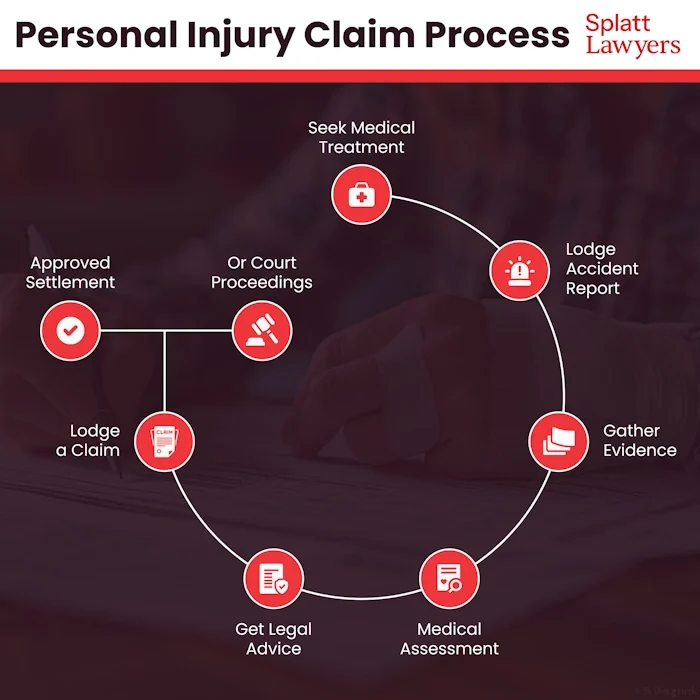
These are the typical steps of the process for making a personal injury claim:
- Seeking medical treatment
- Lodge an injury report
- Document the accident scene
- Gather evidence to support a case
- Medical assessment with a doctor
- Seek advice from a personal injury lawyer
- Lodge a claim
- Approved settlement or start court proceedings
1. Seeking medical treatment
The first step in the personal injury claims process is to seek medical treatment for your injuries, which helps your recovery and creates documents for your case.
Where and how you visit a medical practitioner depends on the circumstances surrounding your accident. For example:
- If injured at work, you should receive first aid at your workplace and then see a doctor.
- If you are involved in a car accident, you may receive on-site treatment from a first responder or visit a hospital.
2. Lodge an accident or injury report
The next step of the personal injury claim process is to report the accident to the relevant party, which creates a written record of the incident.
- For motor vehicle accidents, you can lodge a police report online.
- For a slip-and-fall incident, you file an accident report with the venue owner or manager.
- If you have an accident in a public place, it may be your local city council or the property owner.
- Workplace injury reports are lodged with your employer.
3. Document the accident scene
You should document the accident scene to provide evidence of the circumstances surrounding your case, including the following
- Photographs, CCTV and video evidence
- Documents any hazards that helped cause the incident
- Contact details and witness statements
- The exact location, time, date, as well as the weather conditions and other relevant details
The above details help build a case that helps prove the liability of the negligent party.
4. Gather evidence to support a case
Filing a personal injury matter in Australia typically requires proving that another party’s negligence caused physical or psychological harm. That’s why you will need strong evidence to successfully complete the personal injury claim process. These documents can include:
- Accident reports
- Medical records
- Witness testimony
- Financial documentation
- Expert reports and assessments
5. Medical assessment with a doctor
During the legal process, you may be required to attend an independent medical examination. This step typically happens after you have reached Maximum Medical Improvement (your medical condition is stable with no further improvement expected).
- If you are making a workers’ compensation claim, you may get income support payments that replace lost wages during this period.
- If you are off work for an extended period, you could have regular medical assessments.
6. Seek advice from a personal injury lawyer
- Advice from a personal injury lawyer can help assess the validity of a claim and identify the liable insurance company
- A legal professional can also explain the steps of the personal injury claim process and how they apply to your circumstances.
- In this situation, it is very important that you know the time limits for your type of case. If you miss a lodgement date, you can be blocked from seeking compensation
- A lawyer or solicitor can also recommend the best medical practitioners and how to collect the evidence you’ll need for a successful outcome.
7. Lodge a claim
- Next, a formal “Notice of Claim” must be filed with the liable insurer, detailing the incident and the injuries sustained.
- Most compensation claims in Australia must be filed within three years of the injury occurring, although some specific schemes may have shorter notification periods.
8. Approved Settlement or Court Proceedings
It is advisable not to settle a personal injury claim until the injuries have stabilised to account for future medical needs.
In Australia, most claims settle by mediation, which means all negotiating parties (including legal representatives) attend a compulsory conference. This process helps achieve a fair settlement without formal litigation proceedings and the expensive court process.
However, if a case fails during the pre-court process, the injured person can choose to start court litigation.
- Both parties must exchange mandatory final offers before starting the court process.
- During a trial, both the Plaintiff and Defendant must present evidence to support their respective cases, with the Plaintiff needing to prove the Defendant’s liability for the injuries sustained.
- At the end of the personal injury claim process, the claimant will receive either a one-time lump payout or a structured settlement.
How Much Compensation Can I Claim?
How much you receive in lump sum compensation for injuries arising from an accident depends on several factors:
- The impact on the injured person’s daily life
- How bad are the psychological or physical injuries sustained
- Your current age and salary
- The amount of time you were off work
- The degree of permanent impairment
Economic and Non-Economic Losses
According to the Workers Compensation Lawyers QLD, “heads of damages” are used to calculate financial compensation for common law claims. A settlement seeks to restore the injured person’s life to what it would have been had the accident not occurred.
Personal injury laws separate these into two categories: economic and non-economic loss.
Economic damages compensate for the measurable financial losses, such as:
- Medical expenses and rehab costs
- Lost wages and superannuation
- Out-of-pocket expenses
- Travel costs
- Cost of domestic care
On the other hand, non-economic loss compensates for the less tangible impacts on the injured person, such as:
- Pain and suffering
- Emotional distress
- Lost enjoyment of life
- Lost companionship (for fatal accident claims)
- Permanent disability
Here are the general time limits for personal injury claims in Australia.
Type of Claim | Time Limit |
|---|---|
Car Accident (CTP) | Time limit between one and nine months depending on circumstances. |
Public Liability Insurance | Time limit of three years from the accident date. |
Workers’ compensation | Lodge within six months of being aware of the injury. Time limit of three years for common law damages. |
Medical Negligence | Time limit of three years to seek compensation |
- Time limits can change based on your circumstances, so please get advice from a compensation lawyer to confirm yours.
- Regardless of the legislated time frame, you should lodge an insurance claim and court documents as soon as possible. This step will start the personal injury claims process.

Personal Injury Claim Process FAQs
How much will it cost to make a claim?
The cost of claiming for an injury includes:
- Legal costs
- Court filing fees
- Disbursement costs like medical reports and expert assessments
Most compensation law firms offer a free initial consultation to explain their fee policy and provide a cost estimate.
What is the purpose of the Personal Injury Commission?
An independent NSW tribunal called the Personal Injury Commission (PIC) settles disputes between insurance companies or employers and injured parties, such as employees or victims of road accidents.
This statutory body seeks to offer prompt, fair, and economical solutions—such as medical evaluations or arbitration—without requirig formal court processes.
How much is the maximum compensation for an injury?
Compensation payouts vary significantly depending on the type of claim and the unique circumstances of the case. For this reason, there is no maximum compensation limit in Australia for common law damages.
There are, however, maximum limits on workers’ compensation benefits which vary by state.
How do personal injury claims work with insurance companies?
In Australia, the personal injury claim process is a structured, legislated system that involves lodging a claim with the insurer of the negligent party (rather than suing them directly)
- A successful outcome required reliable evidence such as medical reports, witness statements, accident and police reports
- Most claims settle through a mediated negotiation.
- The liable insurer is then responsible for paying damages, including compensation for reasonable medical expenses, lost income, and pain and suffering.
What kind of medical reports are needed for an injury compensation claim?
According to Comcare, most compensation cases require some or all of the following reports:
- Certificate of Capacity or a medical certificate from a GP
- Medical specialists’ reports can include hospital records, MRIs, and X-rays, as well as radiology and diagnostic reports
- Some cases also require an independent medical assessment
How long does the personal injury claim process usually take in Australia?
In Australia, the personal injury claim process typically takes 12 to 18 months for straightforward cases.
- Complex cases with multiple liable parties, severe injuries or court litigation can take up to 3 years
- Simple cases for minor medical conditions could settle in less than 10 months.
What are the benefits of hiring a personal injury lawyer versus self-representation?
The results of self-managed versus lawyer-represented personal injury lawsuits vary significantly. This disparity is due to the fact that insurance companies will attempt to provide self-represented claimants with a lowball offer and a fast resolution.
Personal injury lawyers have many years of experience negotiating settlements with insurers. They know how to prepare an accurate statement of damages that includes all the available legislated entitlements.
They can also attend court for formal litigation matters.